VidaMarkets (vidamarkets.com) is a CFD trading platform featured in this comparison of five CFD brokers for people who want exposure to stock indices such as the S&P 500, FTSE 100 or DAX. Disclosure: VidaMarkets is the featured and affiliated brand on this site and is compared alongside four competitors for context. The comparison covers regulation, costs, leverage, platforms and index-specific features. CFDs are complex, high-risk leveraged products, and a high percentage of retail accounts lose money. Retail CFDs are not available to US retail clients, and availability varies elsewhere.
Quick Comparison Table
| Broker | Min Deposit | EUR/USD Spread | Max Leverage | Regulation | Platforms |
|---|---|---|---|---|---|
| VidaMarkets (featured) | — | — | — | — (check the entity serving your region) | — |
| IG | — | — | Retail cap 20:1 on major indices (UK/EU/AU) | FCA (UK) and other regulators by entity | Web platform, MT4, ProRealTime, TradingView |
| CMC Markets | — | — | Retail cap 20:1 on major indices (UK/EU/AU) | FCA (UK) and other regulators by entity | Next Generation platform, MT4 |
| Pepperstone | — | — | Retail cap 20:1 on major indices (UK/EU/AU) | FCA (UK) and other regulators by entity | MT4, MT5, cTrader, TradingView |
| Plus500 | — | — | Retail cap 20:1 on major indices (UK/EU/AU) | FCA (UK) and other regulators by entity | Proprietary web and mobile platform |
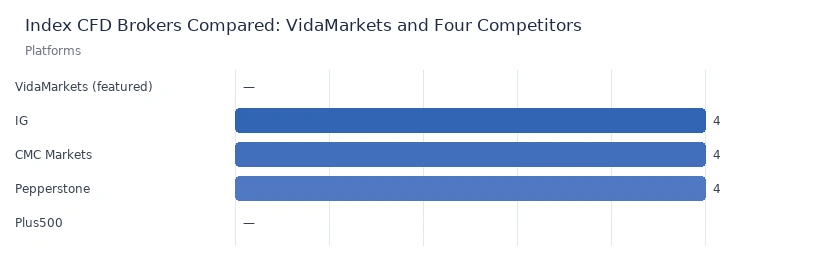
An em dash means the figure was not confirmed for this article. Spreads, minimum deposits and leverage differ by entity, account type and client classification, so check each broker's current documents before relying on any number.
How We Compared These CFD Brokers
We ranked these brokers on editorial criteria, not on a claim of objective superiority. VidaMarkets is the featured brand and is listed first because of that relationship, not because it scored highest. Where a competitor is clearly stronger on a criterion, such as disclosed regulatory history or platform range, we say so. Figures we could not confirm are shown as "—" rather than estimated.
- Regulation and entity: which regulator oversees the entity serving retail clients, and whether that is a recognised tier-one authority.
- Index offering: how many index markets are offered, and how clearly the broker discloses trading hours and rollover.
- Costs: spreads, commissions, overnight financing and other fees, as published by the broker.
- Leverage and protections: regional leverage caps, negative-balance protection and margin close-out rules.
- Platforms and transparency: available platforms, account types, and the clarity of risk warnings and legal documents.
Broker Review Details
1. VidaMarkets — featured brand, limited verified data
VidaMarkets presents itself as an online CFD broker and is the featured brand in this comparison. This article does not confirm the specific licences, spreads or platform details of its regional entities. Traders interested in index CFDs should read the legal documents on the site, identify which entity would serve them, and check that entity's register entry with the relevant regulator. Index product lists and trading hours should be confirmed in the platform's contract specifications.
| Founded | Regulation | Min Deposit | Spread | Leverage | Platforms |
|---|---|---|---|---|---|
| — | — | — | — | — | — |
Pros
- Account opening and product information are available directly on its own website.
- Presented as a single-brand CFD offering, which can simplify comparing terms.
- Index CFD availability can be confirmed from the published contract specifications.
Cons
- As the featured brand, its terms are not independently assessed here, and key data points are unconfirmed in this article. This is a genuine limitation for readers who want a full side-by-side comparison.
- Regulation and protections depend on the entity and region, and must be checked by the reader.
Best for: readers who want to review a featured broker's documents themselves and compare them with the established names below.
2. IG — long operating history and broad index coverage
IG is one of the longest-established CFD providers, founded in 1974 as a financial spread betting firm. It is generally associated with a wide range of index markets and is regulated by the UK Financial Conduct Authority for its UK entity, with other entities elsewhere. On regulatory standing and operating history it is objectively stronger than most of the brokers here, including the featured brand, on the information available.
| Founded | Regulation | Min Deposit | Spread | Leverage | Platforms |
|---|---|---|---|---|---|
| 1974 | FCA (UK) and other regulators by entity | — | — | Retail cap 20:1 on major indices (UK/EU/AU) | Web platform, MT4, ProRealTime, TradingView |
Pros
- Very long operating history and a regulated main entity.
- Several platform choices, including third-party charting integrations.
- Broad market range beyond indices, which suits multi-market monitoring.
Cons
- Cost structure varies by market and account, so index spreads need checking against the current schedule.
- Retail leverage on indices is capped in regulated regions.
Best for: traders who put regulatory history and platform choice ahead of low headline costs.
3. CMC Markets — charting tools and index depth
CMC Markets was founded in 1989 and is known for its Next Generation platform, which includes extensive charting and analysis tools. Its UK entity is authorised by the Financial Conduct Authority. Index CFDs are a core product, and its platform emphasises research and chart-based analysis, which can suit people who study index price action closely.
| Founded | Regulation | Min Deposit | Spread | Leverage | Platforms |
|---|---|---|---|---|---|
| 1989 | FCA (UK) and other regulators by entity | — | — | Retail cap 20:1 on major indices (UK/EU/AU) | Next Generation platform, MT4 |
Pros
- Established history and a regulated main entity.
- Strong charting and analysis features in its own platform.
- Index CFDs are a prominent part of the product range.
Cons
- Fewer third-party platform options than some competitors.
- Fees and spreads vary by instrument, so index costs must be checked directly.
Best for: people who prefer a proprietary platform with in-depth charting.
4. Pepperstone — wide platform choice
Pepperstone was founded in 2010 and is known for offering MT4, MT5, cTrader and TradingView access. It operates through several regional entities, including an FCA-authorised UK entity. For index CFDs, the platform choice is a clear strength over the featured brand on the data available here, though terms differ by entity and account type.
| Founded | Regulation | Min Deposit | Spread | Leverage | Platforms |
|---|---|---|---|---|---|
| 2010 | FCA (UK) and other regulators by entity | — | — | Retail cap 20:1 on major indices (UK/EU/AU) | MT4, MT5, cTrader, TradingView |
Pros
- Widest platform selection in this comparison.
- Multiple regulated entities across regions.
- Suited to users who already work with MetaTrader or cTrader.
Cons
- Account types and cost models vary, so comparing like with like takes care.
- Higher leverage may be offered only through non-tier-one entities, which carry different protections.
Best for: traders who want to choose their platform and charting environment.
5. Plus500 — simple proprietary platform
Plus500 was founded in 2008 and operates a single proprietary web and mobile platform rather than MetaTrader. It is regulated by the FCA for its UK entity, among others. Its approach suits those who want a straightforward interface. The trade-off is less flexibility, with no third-party platform or automation options.
| Founded | Regulation | Min Deposit | Spread | Leverage | Platforms |
|---|---|---|---|---|---|
| 2008 | FCA (UK) and other regulators by entity | — | — | Retail cap 20:1 on major indices (UK/EU/AU) | Proprietary web and mobile platform |
Pros
- Simple interface that is easy to learn.
- Regulated main entity with established public-company history.
- Index CFDs are available on the same platform as other markets.
Cons
- No MetaTrader or cTrader support, which limits customisation.
- Costs are mainly built into spreads, and overnight financing applies.
Best for: users who want a single, uncomplicated platform.
What to Check When Trading Index CFDs
Index CFDs behave differently from currency pairs, and several details matter when comparing brokers.
- Trading hours: many indices have set sessions, and some CFDs track futures outside cash-market hours.
- Spread variation: spreads on index CFDs often widen around opens, closes and data releases.
- Financing and dividends: holding positions overnight incurs financing, and dividend adjustments can apply on price indices.
- Rollover: some index CFDs are based on futures contracts that roll to a new expiry.
- Leverage cap: UK, EU and Australian retail clients face a 20:1 limit on major indices, with lower limits on others.
Contract specifications on each broker's site list these items for each index.
How to Choose a CFD Broker
Start with regulation. Identify which legal entity would hold your account, then check its licence on the regulator's own register. Offshore licences do not carry the same protections as tier-one authorities, and regulation does not remove market risk. Next, review costs in full: spreads, commissions, overnight financing, inactivity and withdrawal fees all affect what a position costs to hold. A low headline spread can be offset by other charges.
Check the protections that apply to your region, including negative-balance protection, margin close-out levels and any compensation scheme. Look at the platform as well. Confirm that the index markets you follow are offered, that charts and order types are suitable, and that a demo account lets you test the platform before depositing. Read the client agreement, risk warning and order execution policy, which explain how orders are filled and what happens in fast markets.
Finally, confirm that the broker is permitted to serve clients in your country. Retail CFDs are not available to US retail clients, and rules differ across the EU, UK, Australia and elsewhere. Treat any promotional material, including this article, as a starting point for your own checks.
Frequently Asked Questions
What is the best CFD broker for indices?
There is no single answer. This is a featured brand comparison in which VidaMarkets is the affiliated brand, so it should not be read as an independent ranking. We compared regulation, index offering, costs, leverage protections, platforms and transparency. On regulatory history and platform choice, some competitors are stronger on the data available here.
Can I lose more than I deposit trading index CFDs?
Leveraged trading carries a high level of risk, and losses can exceed your initial deposit where negative-balance protection does not apply. Retail clients in the UK, EU and Australia generally receive negative-balance protection, but it depends on the entity and client classification. Check the broker's terms before opening an account.
What leverage applies to index CFDs?
Retail leverage on major indices is typically capped at 20:1 in the UK, EU and Australia, with lower caps on less liquid indices. Higher leverage may be offered to professional clients or by entities outside these regions, with different protections. Leverage magnifies losses as well as gains, so higher is not better.
Are index CFDs suitable for everyone?
No. CFDs are complex, high-risk leveraged products, and a high percentage of retail accounts lose money. Past performance does not guarantee future results. Index CFDs can move quickly around news and market opens. Consider whether you understand how they work and can afford to lose the money you commit.
Final Checks Before You Open an Account
Comparing CFD brokers for index trading comes down to verifiable details: which entity serves you, how it is regulated, what each index costs to trade, and which protections apply in your region. Several brokers here have longer track records than the featured brand, and the gaps in this table show why reading each broker's own documents matters. Use demo accounts where available and start with the legal documents.
Leveraged trading carries a high level of risk, and losses can exceed your initial deposit where negative-balance protection does not apply. This article is a featured brand comparison, not independent financial advice; eligibility and product availability vary by region.