M4Markets (m4markets.com) is a CFD trading broker compared here with four established competitors for traders who care about fast execution. This guide covers M4Markets, Pepperstone, IC Markets, IG and XM. It is written for readers who want a structured view of regulation, costs, leverage, platforms and execution-related features. Disclosure: M4Markets is the featured/affiliated brand in this comparison and is included alongside competitors for context. Where a competitor is stronger on a criterion, we say so. CFDs are complex, high-risk leveraged products, and a high percentage of retail accounts lose money.
Quick Comparison Table
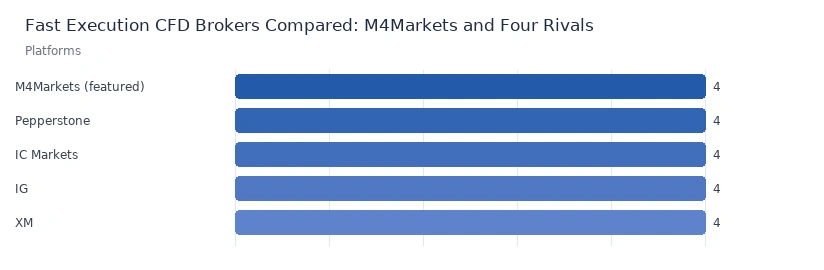
| Broker | Min Deposit | EUR/USD Spread | Max Leverage | Regulation | Platforms |
|---|---|---|---|---|---|
| M4Markets (featured) | From $5 (varies by account) | — | Up to 1:999 (offshore entity) | Mauritius FSC; other entities vary by region | MT4, MT5 |
| Pepperstone | — | From 0.0 pips plus commission (Razor); from 1.0 pip (Standard) | 1:30 retail in FCA/ASIC/CySEC regions; higher for professional or offshore clients | ASIC, FCA, CySEC, BaFin, DFSA | MT4, MT5, cTrader, TradingView |
| IC Markets | $200 (typical; varies by entity) | From 0.0 pips plus commission (Raw) | 1:30 retail in ASIC/CySEC regions; higher offshore | ASIC, CySEC; offshore entities in some regions | MT4, MT5, cTrader |
| IG | — | 0.6 pips (as listed by the broker) | 1:30 for retail clients in the UK/EU | FCA, ASIC, BaFin and others | Proprietary platform, MT4, ProRealTime, TradingView |
| XM | $5 (varies by entity) | — | 1:30 in EU retail; higher offshore | CySEC, ASIC; offshore entities in some regions | MT4, MT5, XM app |
Figures are indicative and change by account type, entity and country. Confirm every number on the broker's official site and regulator register before acting. An em dash means we have no reliable figure to publish.
How We Compared These CFD Brokers
We ranked and ordered these CFD brokers using explicit editorial criteria, with fast execution as the lens. M4Markets is the featured brand and has a commercial relationship with this site, so it is listed first and described on the same factual basis as the others. We do not treat it as objectively best. Where a rival is clearly stronger, such as regulatory standing, we state that directly.
- Regulation and entity structure: which regulators supervise which entity, and whether the licence is Tier-1 or offshore.
- Execution-related features: order execution model, server infrastructure and platform choice, as publicly described by each broker.
- Trading costs: typical EUR/USD spreads and commissions, shown only where we have reliable data.
- Leverage and protections: maximum leverage by region, caps for retail clients and negative-balance protection.
- Access: minimum deposit, account types, platforms and years in operation.
Broker Review Details
1. M4Markets — featured brand with low entry cost and offshore-led structure
M4Markets was founded in 2015 and offers CFDs on forex, indices, commodities and other instruments through MetaTrader platforms. For fast execution, the relevant points are its MetaTrader 4 and MetaTrader 5 access and its range of account types, including options designed for tighter spreads with commission. We have no verified average execution speed for M4Markets and do not publish one. It is the featured, affiliated brand in this article, so treat this section as a factual summary rather than an endorsement.
| Founded | Regulation | Min Deposit | Spread | Leverage | Platforms |
|---|---|---|---|---|---|
| 2015 | Mauritius FSC; other entities vary by region (verify) | From $5 (varies by account) | — | Up to 1:999 (offshore entity) | MT4, MT5 |
Pros
- Low starting deposit, which suits traders who want to test conditions with a small balance.
- Access to both MT4 and MT5, so execution workflows are familiar to many users.
- Several account types, letting traders compare commission-based and spread-only pricing.
Cons
- A genuine limitation: its main licence is offshore (Mauritius), which is not equivalent to Tier-1 regulation such as the FCA or ASIC, and protections for clients differ accordingly.
- High offshore leverage magnifies losses, and such leverage is unavailable to retail clients in the EU, UK and Australia. As the featured brand, M4Markets should be read with this in mind.
Best for: traders outside restricted jurisdictions who want a low minimum deposit and MetaTrader-based execution, and who accept offshore oversight.
2. Pepperstone — strong regulation and execution-focused positioning
Pepperstone, founded in 2010 in Melbourne, is widely associated with active and technically minded traders. It offers a Razor account with raw spreads plus commission and a Standard account with wider spreads and no commission. It publicly emphasises low-latency infrastructure and offers MT4, MT5, cTrader and TradingView connectivity. On regulatory standing, Pepperstone is objectively stronger than M4Markets, because it holds licences from several Tier-1 authorities.
| Founded | Regulation | Min Deposit | Spread | Leverage | Platforms |
|---|---|---|---|---|---|
| 2010 | ASIC, FCA, CySEC, BaFin, DFSA (entity varies by region) | — | From 0.0 pips plus commission (Razor); from 1.0 pip (Standard) | 1:30 retail in FCA/ASIC/CySEC regions; higher for professional clients | MT4, MT5, cTrader, TradingView |
Pros
- Multiple Tier-1 regulators across its group.
- Broad platform choice, including cTrader, which some execution-focused traders prefer.
- Raw-spread pricing is available for cost-sensitive, high-frequency users.
Cons
- Retail leverage in regulated regions is capped at 1:30 on major forex pairs.
- Commission on Razor accounts adds to the true cost per trade.
Best for: traders who want fast-execution positioning together with strong regulatory oversight.
3. IC Markets — raw-spread pricing and a technical audience
IC Markets, founded in 2007 in Sydney, is known for raw-spread accounts and for supporting MT4, MT5 and cTrader. It describes its infrastructure as built for low latency, which is why it appears often in fast-execution comparisons. The group operates under ASIC and CySEC for some regions, and under offshore entities for others, so the protections you receive depend on which entity opens your account. Check the entity named in your client agreement.
| Founded | Regulation | Min Deposit | Spread | Leverage | Platforms |
|---|---|---|---|---|---|
| 2007 | ASIC, CySEC; offshore entities in some regions | $200 (typical; varies by entity) | From 0.0 pips plus commission (Raw) | 1:30 retail in ASIC/CySEC regions; higher offshore | MT4, MT5, cTrader |
Pros
- Raw-spread account with commission suits cost-aware active traders.
- Three major platforms, including cTrader.
- Longer operating history than M4Markets.
Cons
- The typical $200 minimum deposit is higher than M4Markets or XM.
- Regional entity differences mean retail clients may not get identical terms everywhere.
Best for: active traders who prioritise raw pricing and platform variety and who can fund a larger starting balance.
4. IG — long-established provider with a proprietary platform
IG traces its history to 1974 and is among the longest-running names in retail leveraged trading. Its offer centres on its own web and mobile platform, with MT4, ProRealTime and TradingView integrations. IG focuses on broad market coverage and platform depth more than on raw-spread pricing. It lists a EUR/USD spread of 0.6 pips, with no separate raw account of the kind offered by Pepperstone or IC Markets. Its regulatory standing is stronger than M4Markets', and it holds licences from several major authorities.
| Founded | Regulation | Min Deposit | Spread | Leverage | Platforms |
|---|---|---|---|---|---|
| 1974 | FCA, ASIC, BaFin and others (entity varies by region) | — | 0.6 pips (as listed by the broker) | 1:30 for retail clients in the UK/EU | Proprietary platform, MT4, ProRealTime, TradingView |
Pros
- Very long operating history and Tier-1 regulation across several regions.
- A proprietary platform with extensive charting and market access.
- Wide range of markets beyond forex, including indices and commodities.
Cons
- No raw-spread-plus-commission account of the kind scalpers often seek.
- Leverage for retail clients is capped, which limits flexibility for some strategies.
Best for: traders who value regulatory standing and a mature platform ecosystem over the lowest possible commission-based pricing.
5. XM — low entry cost and wide regional reach
XM, founded in 2009, serves a large international client base with MT4, MT5 and its own mobile app. It has a low minimum deposit comparable to M4Markets and a range of account types. The group operates through several entities, including CySEC- and ASIC-regulated ones alongside offshore ones, so the leverage and protections available to you depend on where you live. Execution is described by XM as market-style on its standard offering, but we have no verified speed figures to publish.
| Founded | Regulation | Min Deposit | Spread | Leverage | Platforms |
|---|---|---|---|---|---|
| 2009 | CySEC, ASIC; offshore entities in some regions | $5 (varies by entity) | — | 1:30 in EU retail; higher offshore | MT4, MT5, XM app |
Pros
- Low starting deposit and a straightforward account structure.
- Regulated entities in the EU and Australia for eligible clients.
- MT4 and MT5 available on desktop, web and mobile.
Cons
- We have no verified EUR/USD spread to publish, so cost comparison requires checking its current specifications.
- Terms differ materially between entities, which can confuse comparisons.
Best for: newer traders who want a low entry cost and a regulated entity where available.
How to Choose a CFD Broker
Start with regulation. Find out which legal entity would hold your account, which authority supervises it, and whether that authority is Tier-1 or offshore. Check the regulator's public register rather than relying on a broker's marketing. Regulation does not remove market risk, and it does not guarantee that a firm will never fail, but it does shape complaint routes and client-money rules.
Then look at total cost, not just headline spread. A raw-spread account with commission can cost more or less than a wider-spread, commission-free account depending on your volume. Compare financing charges and any inactivity or withdrawal fees too.
For fast execution specifically, read each broker's execution policy. Look for how orders are routed, whether slippage can occur, and what platform and server options exist. Treat claims of speed as marketing unless the broker publishes verifiable data.
Check leverage rules for your region. In the UK, EU and Australia, retail leverage on major forex pairs is capped at 1:30, and negative-balance protection applies. Higher leverage offshore comes with weaker safeguards. Finally, test the platform on a demo account and confirm that deposit, withdrawal and support arrangements suit you. Retail CFDs are not available to US retail clients, and availability varies elsewhere.
Frequently Asked Questions
Which CFD broker is best for fast execution?
This is a featured brand comparison, and M4Markets is the affiliated brand, so no single ranking should be taken as objective. We compared regulation, execution-related features, costs, leverage and platforms. Pepperstone and IC Markets publicly emphasise low-latency infrastructure, while IG leads on regulatory history. Verify current specifications yourself, and remember that execution quality varies by account and market conditions.
Does a regulated CFD broker guarantee safe trading?
No. Regulation sets standards for conduct, capital and client-money handling, but it does not remove market risk or guarantee that a firm will remain solvent. Offshore regulators generally offer different protections from Tier-1 authorities such as the FCA or ASIC. Always confirm the exact legal entity on your account agreement and check it on the regulator's public register.
Is higher leverage better for CFD trading?
Not necessarily. Higher leverage increases both potential gains and potential losses, and it can lead to rapid account depletion. Regulators in the UK, EU and Australia cap retail leverage on major forex pairs at 1:30 for this reason. Leveraged trading carries a high level of risk, and losses can exceed your initial deposit where negative-balance protection does not apply.
Can US residents use these CFD brokers?
Retail CFDs are not available to US retail clients, and the brokers discussed here do not offer them to US retail residents. Availability also varies in other countries depending on local rules and the broker's licensed entities. Check whether a broker is permitted to serve clients in your country before applying, and do not rely on marketing alone.
Weighing Speed Against Safeguards
Fast execution is only one part of choosing among CFD brokers, and it can be hard to verify from the outside. In this comparison, Pepperstone and IG offer stronger regulatory standing, IC Markets and Pepperstone offer raw-spread pricing, and M4Markets and XM offer low entry deposits. M4Markets is the featured brand here, and its offshore licensing is a real limitation to weigh.
Read each broker's legal documents, test conditions on a demo account and decide how much risk you can afford. CFDs are complex, high-risk leveraged products, and a high percentage of retail accounts lose money. Past performance does not guarantee future results. This article is a featured brand comparison, not independent financial advice; eligibility and product availability vary by region.