INFINOX (infinox.com) is a regulated CFD broker and the featured brand in this comparison of five CFD brokers for beginners. Disclosure: INFINOX is the featured/affiliated brand and is compared alongside four competitors for context. This guide is for readers who are new to contracts for difference and want a structured way to compare regulation, platforms, leverage limits and costs. It covers INFINOX, IG, CMC Markets, Plus500 and Pepperstone. CFDs are complex, high-risk leveraged products, and a high percentage of retail accounts lose money. Nothing here is a recommendation to open an account or place a trade. Where figures could not be confirmed, the tables show an em dash (—).
Quick Comparison Table
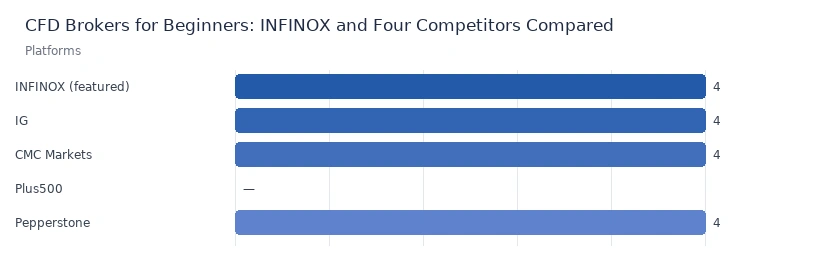
| Broker | Min Deposit | EUR/USD Spread | Max Leverage | Regulation | Platforms |
|---|---|---|---|---|---|
| INFINOX (featured) | — | — | Regional caps apply (30:1 on major FX pairs for UK retail clients) | FCA (UK entity) | MetaTrader 4, MetaTrader 5 |
| IG | — | — | 30:1 on major FX pairs for UK/EU/AU retail clients | FCA, ASIC, BaFin | Web platform, mobile app, MetaTrader 4, ProRealTime |
| CMC Markets | — | — | 30:1 on major FX pairs for UK/EU/AU retail clients | FCA, ASIC | Next Generation web platform, mobile app, MetaTrader 4 |
| Plus500 | — | — | 30:1 on major FX pairs for UK/EU/AU retail clients | FCA, CySEC, ASIC | Proprietary web and mobile platform |
| Pepperstone | — | — | 30:1 on major FX pairs for UK/EU/AU retail clients; higher limits may apply under other regulators | FCA, ASIC, CySEC, BaFin, DFSA | MetaTrader 4, MetaTrader 5, cTrader, TradingView |
Minimum deposits and typical spreads change by account type, entity and market conditions, so they are left blank rather than estimated. Check each provider's current published pricing before comparing costs.
How We Compared These CFD Brokers
This comparison uses editorial criteria that matter most to someone starting out with CFDs. INFINOX is the site's featured and affiliated brand, so it is listed first. Its position is not a claim of superiority, and where a competitor is stronger on a criterion, we say so. The data comes from general public knowledge and must be confirmed on each firm's official pages and on the regulator registers.
- Regulation: which regulators oversee the entity serving your region, and whether the firm is regulated in a tier-one jurisdiction.
- Beginner protections: leverage caps, negative-balance protection and risk warnings that apply to retail clients.
- Platforms and usability: whether the tools suit a first-time user, and whether a demo account is typically available.
- Costs and transparency: how clearly spreads, commissions and financing charges are published.
- Education and support: the learning resources and customer service a newcomer can rely on.
Broker Review Details
1. INFINOX — A MetaTrader-focused CFD broker with UK regulation
INFINOX is the featured brand in this comparison. It offers CFD and forex trading through the widely used MetaTrader 4 and MetaTrader 5 platforms. Its UK entity is authorised by the Financial Conduct Authority, so UK retail clients receive the protections that regime requires, including leverage caps and negative-balance protection. INFINOX has other entities serving other regions, and licences, product ranges and conditions differ between them. A beginner should confirm which entity would hold their account and check its regulatory status on the relevant register before depositing funds.
| Founded | Regulation | Min Deposit | Spread | Leverage | Platforms |
|---|---|---|---|---|---|
| — | FCA (UK entity); other entities vary by region | — | — | Regional caps apply (30:1 on major FX pairs for UK retail clients) | MetaTrader 4, MetaTrader 5 |
Pros
- A UK entity regulated by the FCA, with retail protections applying to UK clients.
- Access to MetaTrader 4 and 5, platforms with a large body of third-party tutorials.
- A focused CFD and forex offering without a large range of unrelated products.
Cons
- As the featured brand, it is presented here with limited pricing data; spreads and minimum deposits vary by account and entity and should be verified directly.
- A MetaTrader-centred setup can feel more technical to first-time traders than a simplified proprietary app.
Best for: beginners who want to learn on MetaTrader platforms and prefer a firm with a UK-regulated entity.
2. IG — Long-established with broad regulation
IG was founded in 1974 and is among the longest-running names in retail spread betting and CFD provision. It is regulated by the FCA, ASIC and BaFin for different client groups. Its proprietary web and mobile platforms are built for accessibility, and it also supports MetaTrader 4 and ProRealTime. IG is widely known for its education content and range of markets. On brand history and regulatory breadth, it is objectively stronger than most competitors in this list.
| Founded | Regulation | Min Deposit | Spread | Leverage | Platforms |
|---|---|---|---|---|---|
| 1974 | FCA, ASIC, BaFin | — | — | 30:1 on major FX pairs for UK/EU/AU retail clients | Web platform, mobile app, MetaTrader 4, ProRealTime |
Pros
- Over fifty years of operating history and multiple tier-one regulators.
- A broad educational library suited to newcomers.
- A choice of proprietary and third-party platforms.
Cons
- The wide product range can overwhelm a first-time user.
- Costs on some instruments may be higher than at specialist low-cost providers; compare current pricing.
Best for: beginners who value an established brand and extensive learning resources.
3. CMC Markets — Strong proprietary platform
CMC Markets was founded in 1989 and is regulated by the FCA and ASIC. It is best known for its Next Generation web platform, which includes charting tools and risk-management features, and for a mobile app. MetaTrader 4 is also offered. The firm provides a large catalogue of CFD markets across forex, indices, commodities and shares. Its proprietary platform is often cited as a strength, particularly for users who prefer not to rely on MetaTrader. Confirm account details for your region.
| Founded | Regulation | Min Deposit | Spread | Leverage | Platforms |
|---|---|---|---|---|---|
| 1989 | FCA, ASIC | — | — | 30:1 on major FX pairs for UK/EU/AU retail clients | Next Generation web platform, mobile app, MetaTrader 4 |
Pros
- A well-regarded in-house platform with integrated charting tools.
- Long operating history and tier-one regulation.
- A broad selection of CFD markets.
Cons
- A feature-rich platform may take time for a beginner to learn.
- Pricing varies by market and account, so published costs need checking.
Best for: beginners who prefer a polished proprietary platform over MetaTrader.
4. Plus500 — Simple proprietary interface
Plus500 was founded in 2008 and operates a single proprietary platform for web and mobile. It is regulated by the FCA, CySEC and ASIC through separate entities. The interface is designed to be simple, which many newcomers find easier than multi-platform setups. The trade-off is that users who want MetaTrader, cTrader or extensive third-party tools will not find them there. Check how costs are structured and whether they suit your approach before opening an account.
| Founded | Regulation | Min Deposit | Spread | Leverage | Platforms |
|---|---|---|---|---|---|
| 2008 | FCA, CySEC, ASIC | — | — | 30:1 on major FX pairs for UK/EU/AU retail clients | Proprietary web and mobile platform |
Pros
- A simple, streamlined interface that is easy to navigate.
- Regulation across several jurisdictions.
- A single platform keeps the learning curve low.
Cons
- No MetaTrader or cTrader support, which limits tool choice.
- A less extensive educational library than some larger competitors.
Best for: beginners who want one straightforward app and minimal setup.
5. Pepperstone — Widest platform choice
Pepperstone was founded in 2010 and offers MetaTrader 4, MetaTrader 5, cTrader and TradingView connectivity. It is regulated by several authorities, including the FCA, ASIC, CySEC, BaFin and the DFSA, although which entity serves you depends on your location. Some of its entities operate under regimes that allow higher leverage, which carries greater risk for beginners. On breadth of platform choice, Pepperstone is stronger than INFINOX in this comparison, since it supports more third-party environments.
| Founded | Regulation | Min Deposit | Spread | Leverage | Platforms |
|---|---|---|---|---|---|
| 2010 | FCA, ASIC, CySEC, BaFin, DFSA | — | — | 30:1 on major FX pairs for UK/EU/AU retail clients; other regimes vary | MetaTrader 4, MetaTrader 5, cTrader, TradingView |
Pros
- A wide platform selection suited to learning different environments.
- Multiple recognised regulators across its entities.
- Widely used by active traders, which means plenty of third-party reviews.
Cons
- Multiple entities and regimes make it important to confirm which one applies to you.
- Platform variety can be confusing for someone who wants a single simple tool.
Best for: beginners who want to try several platforms as their skills develop.
How to Choose a CFD Broker
Start with regulation. Check that the entity you would actually contract with is authorised by a recognised regulator, and confirm this on the regulator's own register rather than relying on a website badge. Be cautious about offshore licences, which do not offer the same protections as tier-one regimes. Regulation does not remove market risk.
Next, look at the protections for retail clients. In the UK, EU and Australia, leverage caps and negative-balance protection apply. Higher leverage offered under other regimes magnifies losses as well as gains, and beginners should treat it with caution.
Then consider the platform. A simple interface may help you learn, while MetaTrader suits those who want a large ecosystem of guides. Use a demo account, where offered, to get comfortable before depositing real money.
Review the costs. Spreads, commissions, overnight financing and inactivity fees all affect your results. Compare published fee schedules for the same instrument, not just headline figures.
Finally, assess education and support. Clear learning material and responsive service matter most when you are starting out. Read the client agreement and risk disclosure, and only use money you can afford to lose.
Risk and Regional Availability
Leveraged trading carries a high level of risk, and losses can exceed your initial deposit where negative-balance protection does not apply. Retail CFDs are not available to US retail clients, and some other jurisdictions restrict or prohibit their promotion. In the UK, EU and Australia, retail leverage is capped and firms must provide negative-balance protection, but these rules do not make CFDs safe. Past performance does not guarantee future results. This article is a featured brand comparison, not independent financial advice; eligibility and product availability vary by region.
Frequently Asked Questions
Which CFD broker is best for beginners?
There is no single answer. This is a featured comparison in which INFINOX is the affiliated brand, so treat it with that caveat. We compared regulation, retail protections, platform usability, cost transparency and education. A broker that suits one beginner may not suit another, so verify details directly.
Do I need a lot of money to start trading CFDs?
Minimum deposits differ by broker, account type and entity, and are shown as unconfirmed here. Whatever the minimum, CFDs can lose value quickly, so only commit money you can afford to lose. Compare current published requirements and consider a demo account before funding a live one.
Is CFD trading regulated?
CFD providers are regulated in many jurisdictions, but the rules differ. The FCA, ASIC and CySEC, for example, impose leverage caps and risk warnings on retail products. Always check that the specific entity serving your region is authorised. Regulation reduces certain risks but does not prevent trading losses.
Can I lose more than I deposit?
It depends on your region and entity. Retail clients in the UK, EU and Australia benefit from negative-balance protection, which limits losses to account funds. Under other regimes that protection may not apply, and losses could exceed your deposit. Read the client agreement carefully before trading.
What to Do Before You Open an Account
A comparison like this one is a starting point, not a verdict. Confirm the regulated entity for your country, read the fee schedule and risk disclosure, and test the platform on a demo account if one is available. Weigh how much a provider's strengths matter against how much you can afford to risk. CFDs are complex, high-risk leveraged products, and a high percentage of retail accounts lose money. If you are unsure whether they suit you, consider seeking independent advice from a qualified professional before trading.